|
I put the wrong link to this September newsletter in my October newsletter that went out on Oct 1... Click here to access the October newletter. 
Hello again! I hope those who have started the school year recently are off to a good start! |
1. Math Mammoth newsNo big new at this time, everything is calm, cool, and collected. 😀 But here is one testimonial:I have a degree in Chemistry and Medicine. I love math and pretty much taught it to my 4 boys as they went thru Christian school. Now my grandsons are home schooled. I am teaching math using your books. I am very impressed with the organization, thoroughness, and care to be precise. The books are wonderful. It makes it very easy to teach, and reminds for of all the things I have forgotten. Thanks for providing this resource! |
2. Online practice: Estimate the Result, Then Calculate Exactly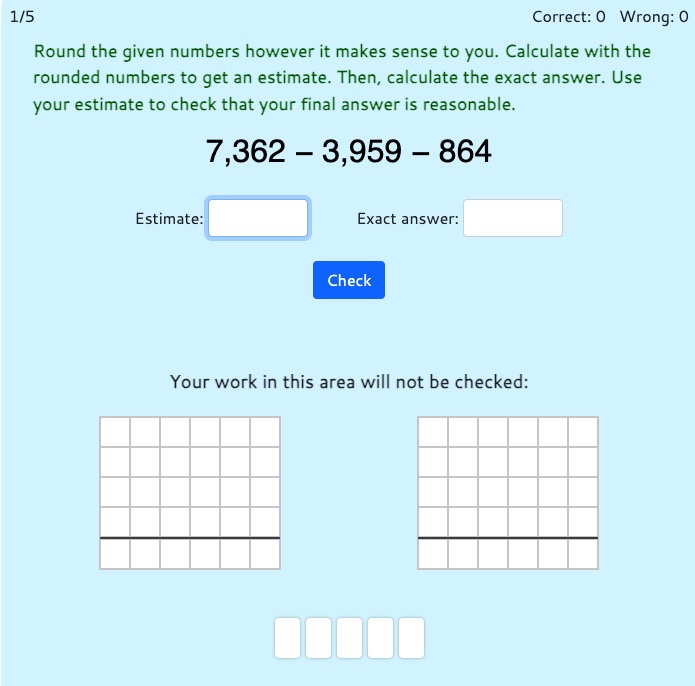 For each question, we provide an interactive grid paper where you can calculate the sums and differences, just like you would using pencil & paper. To come up with the estimate, you should round the given numbers either to largest place that the numbers have, or to the second largest. For example, if the question has three-digit numbers, round them either to the nearest hundred or to the nearest ten. The script will not tell you how to round, and it will accept estimations based on these different types of rounding as correct. |
3. Review: Word Problem WorkshopThe following is my review of the book "Word Problem Workshop", which is essentially meant for classroom teachers. The reason I wrote it is because I feel the need to provide resources and support for schools and teachers that are using Math Mammoth.I feel the Word Problem Workshop routine fits in well with the Math Mammoth curriculum (for classrooms), and is a great idea to help children learn to solve word problems.  Mona Iehl used to teach math like most everyone else: show on the whiteboard how to work a problem, and then let students mimic it. You know...
"I do, we do, you do."
Mona Iehl used to teach math like most everyone else: show on the whiteboard how to work a problem, and then let students mimic it. You know...
"I do, we do, you do."
But then one day, all that changed. Another teacher, Linda, modeled a lesson in her 3rd grade classroom. That lesson led to a profound realization for Mona as a math teacher, and to a journey that transformed her math teaching approach. She was awakened to the fact that math isn't just about the right answer. "I realized that math class should be a space where students aren't just following instructions—they should be actively engaging with the material and each other, sharing ideas, discussing solutions, and building a sense of community around learning.She started to teach differently. Her classroom became a place where students could confidently solve problems, discuss their reasoning, and think deeply about math. Mona says that her book isn't just a strategy book — it's a movement to change the way we teach math. Word Problem Workshop is a structure, or a process, or a routine within the math classroom that she has taught to many other teachers in her work as a math coach. What is Word Problem Workshop?It is a daily twenty-or-so-minute routine during which students solve one or two word problems, and then discuss their approaches to that problem. They collaborate, and actually build a community around learning.This routine fosters critical thinking, encourages productive struggle, and builds resilience in students. It also aims to create a classroom environment in which students can work together, learn from each other, learn to communicate, and form a community. It helps students become confident, lifelong problem solvers.  The entire workshop can fit into your math block in various ways (see the image), but she recommends doing it very near the beginning.
Read on! |
4. Math Mammoth Kindergarten manipulative package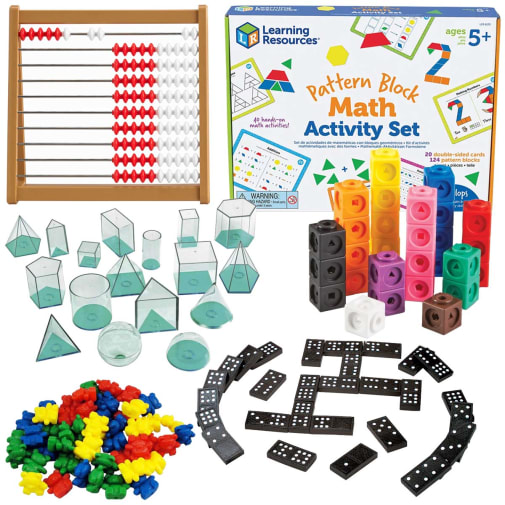 Rainbow Resource Center has put together a manipulative package for Math Mammoth Kindergarten! I do also provide a list of recommended manipulatives (see this page and scroll down to "manipulatives"), if you prefer to piece it together yourself, but Rainbow's bundle product can make it easier. |
5. Grading students' work in a classroomA teacher from a small school sent in a question that I hope some of you have ideas for! It has to do with grading students' seat work.I own and run a small Classical Christian school in Arkansas. We switched to Math Mammoth a couple of years ago and have been very pleased with the methodology. For grades K-3 the product works very well in a classroom setting. However, we are struggling with the grades above that. Mostly it is just with work flow. Most other curriculums that we have used switch to a reusable hardbound text from around 3rd or 4th grade. This requires students to copy their work, but it also allows them to have a book with all of the instructions and turn in their seatwork for the teacher to grade. We have tried using workbooks and we have tried printing pages from the digital text. For a teacher a stack of workbooks to take home and grade becomes cumbersome. That also leave students without books for study etc. If we print pages from the digital text, it can become an organizational issue for the students when the pages have been graded and returned. If they don't keep all of their returned work, they don't have pages for studying for tests etc. How are other schools overcoming this issue?Here are my ideas...
Marie JAny other ideas? You can reply to this email or share your thoughts on my Facebook post. |
6. Just for fun!
Thanks for reading! 🙂 Feel free to forward this issue to a friend/colleague! Subscribe here. Till next time, Maria Miller |
| Complete curriculum | Math games and interactive practice | Math Mammoth freebies | New to MM? Start here |
| Privacy & your personal data | Simon the Son of Jona Vs Peter | Blue Series: For filling in gaps |